Choosing where to submit a paper involves its subject and readers, publication options, costs and the review process. Wiley’s webinar Open Access Publishing Success: A Guide for Authors, dated 14 October 2026, offered a useful way to consider these decisions from an author’s perspective. The presenter was Dr. Axel Straube, an editor at Wiley-VCH.
In the earlier Note on the Elsevier author workshop, I described manuscript structure and submission preparation. Here I focus on open access conditions, journal selection and responding to editorial decisions. I also want to retain the questions about funding, appeals after rejection and potential bias in peer review.
What to check about open access
Open access (OA) allows readers to read a paper without a subscription or individual payment. The applicable licence determines how it may be reused. Free access and unrestricted reuse need to be distinguished.
Reasons for choosing OA include funder requirements as well as access for readers. Before submission, check the publication model, licence and funder’s requirements together. Wiley’s open access overview is a useful reference.
| Option | What to check |
|---|---|
| Gold OA journal | How articles are made open, article publication charges (APCs), and discount or waiver conditions |
| Hybrid journal | Whether OA is available within the subscription journal, its cost and applicable support |
| Subscription publication route | Reader access, any separate publication charges, and compliance with funder requirements |
The Gold OA label alone does not establish that every journal has the same charging arrangements. For hybrid journals, check the costs of choosing OA separately from the conditions of the subscription route.
Questions about costs and support
The discussion included questions about the price of OA and whether it costs less than subscription publication. There is no single answer across journals. Check the APC first, then investigate any discounts or waivers. A subscription route does not necessarily mean that every kind of charge is absent.
An agreement between an institution and a publisher may provide support. Eligibility can depend on the journal, the corresponding author’s affiliation, the applicable dates and other conditions, so the institutional library is a useful point of contact. Research4Life was also mentioned in relation to country-based support, but a country or institutional affiliation alone should not be taken as confirmation of eligibility.
I still need to establish what support applies to me. Publication conditions and funding belong in the journal shortlist stage, rather than becoming a cost question only after the manuscript is complete.
Choosing a journal for the research and its readers
Start with whether the research fits the journal’s scope and audience. Read recent papers to compare the questions, methods and level of contribution it publishes. The journals that have published related work can also help narrow the candidates.
One question concerned acceptance in journals with a high impact factor (IF). IF is a journal-level metric and does not directly measure the quality of an individual paper. Assess the novelty and contribution realistically, then identify the readers who need the findings. A specialist journal may reach a more appropriate audience.
For each candidate, check accepted article types, such as original research and reviews, publication options, review and publication times, and funding requirements. Wiley Journal Finder can suggest candidates using an abstract. Its results still need to be assessed against the journal’s scope and recent papers. The same manuscript must not be submitted to several journals simultaneously.
Checking the publisher’s credibility
An email promising rapid acceptance, or a title resembling a familiar journal, is insufficient grounds for choosing a publication. Check the editorial board, published papers, review process and transparency about charges. Editorial names used without their consent are another warning sign.
For OA journals, DOAJ is one place to check information. Librarians and researchers in the field can help when a journal is difficult to assess. Consider several sources of evidence about its operation rather than treating presence or absence in a single directory as a complete judgement.
Initial editorial assessment and external review
After submission, the editor checks scope, article type, basic readability and research ethics. Depending on the journal, novelty, importance and reader interest are also central criteria. A manuscript may be rejected at this stage without external review.
Similarity screening also needs context. A match could involve a methods description, a properly marked quotation or material used without attribution. A percentage alone cannot determine whether plagiarism has occurred.
External reviewers assess matters such as methods, reproducibility and whether the results support the conclusions. Their reports inform the editor, who makes the final decision. Review should not be understood as a simple vote counting favourable and unfavourable recommendations.
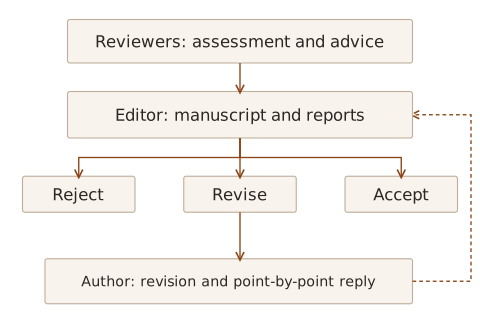
This diagram summarises decisions and revision after external review. The actual procedure can include another round of external review, depending on the journal and manuscript.
Peer review helps identify problems and improve a manuscript. It cannot reliably detect every instance of data fabrication or duplicate publication, or guarantee quality and future impact. Authors remain responsible for the accuracy and integrity of the research.
What to examine after rejection
Read the editor’s decision and the reviewers’ comments separately. The next step depends on whether the issue is journal fit, an insufficiently explained contribution, or a problem with methods or evidence.
A question about responding to rejection by the same journal led to a discussion of appeals. If an editor or reviewer has misunderstood a central point or overlooked important evidence, an author can request reconsideration with specific, courteous reasons. That differs from submitting an unchanged manuscript again shortly afterwards. Any appeal must follow the journal’s procedure.
Asked about acceptance and rejection rates, the presenter described them as statistics resulting from editorial outcomes. His explanation was that individual papers are not rejected to meet an internal quota for a particular rate.
Questions about bias in review
The presenter acknowledged that bias is possible when reviewers can see authors’ names and affiliations. He also advised examining the substance of the comments objectively before attributing an individual rejection to bias.
In single-anonymous review, authors do not know the reviewers’ identities. Double-anonymous review also conceals the authors’ identities from reviewers. Research topics, citations or previously shared material can still allow an identity to be inferred, so double-anonymous review cannot eliminate every form of bias. Check the journal’s policy for its actual anonymity and disclosure arrangements.
Carrying the revision response into the manuscript
For a revision request, work through each comment and explain the changes in a point-by-point response. Where a request is not followed, give reasons and evidence, with an alternative where appropriate. If the evidence does not adequately support a claim, further analysis or more cautious wording may be needed.
The point I particularly want to retain is that explanations in the response also need to reach the manuscript. If methods or limitations are clarified only in the response letter, readers of the published paper will never see that clarification. Identifying the location and content of changes also helps editors and reviewers assess the revision.
The purpose is to examine the explanation and evidence, rather than rebut every comment. The result should be a clearer manuscript for its eventual readers.
Writing accurately, briefly and clearly
The writing principles can be summarised as Accurate, Brief and Clear. Accuracy requires quantities, conditions and comparison criteria in place of vague evaluations. Brevity should retain the detail needed for meaning and reproducibility. Clear writing reduces unnecessarily complex noun phrases and uses verbs to show what was done.
Organise the paper around the research question and findings rather than listing everything in the order it happened. Methods need the relevant procedures and conditions; results and discussion need a clear distinction between evidence, interpretation and limitations. One useful approach is to establish the main figures and sequence of findings, write the body, and then refine the title and abstract.
| Part of the manuscript | Question to revisit |
|---|---|
| Title | Does it convey the central message without unnecessary abbreviations or exaggeration? |
| Abstract | Can it explain the question, approach, main findings and significance without the full paper? |
| Keywords | Are these terms readers would actually search for? |
| References | Do they give balanced coverage of recent research and conflicting findings? |
| Figures and text | Are terminology, abbreviations, units and presentation consistent and connected? |
| Cover letter | Does it explain the contribution and journal fit rather than repeat the abstract? |
Follow the target journal’s requirements for abstract length and keyword count. The cover letter should also accurately disclose relevant context, including conflicts of interest or related manuscripts. A final check should catch a journal or editor name left over from another submission.
Human responsibility when using AI
AI use needs to be disclosed transparently, and people remain responsible for manuscript accuracy. Tools such as ChatGPT cannot be listed as authors. Fluent wording still requires direct checks of facts, citations and interpretation.
Basic spelling and grammar correction needs to be distinguished from generating content or substantially revising a manuscript. Product names alone should not determine disclosure requirements. Check the AI section of Wiley’s publishing ethics guidance and the individual journal’s rules at submission, considering what was actually used and how. AI use in figures needs a separate check of permitted uses and disclosure requirements.
Author support resources to revisit
It helps to distinguish the roles of tools available during preparation, publication and later work.
| Tool or resource | Possible use |
|---|---|
| Wiley Journal Finder | Finding candidate journals from an abstract and search criteria |
| Manuscript Language Checker and Wiley Editing Services | Language checks, editing, translation and manuscript formatting support |
| Wiley Author Services and Author Dashboard | Following submission and publication progress and OA procedures |
| Authorea | Collaborative writing and connecting references and research material |
| GetFTR and ORCID | Checking available full-text access routes, and linking researcher identity and contributions |
| Wiley Researcher Academy and author webinars | Further learning about publication and manuscript preparation |
A language assessment does not establish scientific validity or guarantee acceptance. These resources can support the stage where they are needed. Wiley Author Services and the author webinars and events page provide starting points for finding relevant material again.
Criteria to carry into my own manuscript
When shortlisting journals, I intend to consider the research question, readers, publication conditions and funding together. After review, I need to understand the reasons for the decision and ensure that improvements described in the response reach the final manuscript. I want submission preparation to include how the research will reach its readers, alongside completing the manuscript itself.